

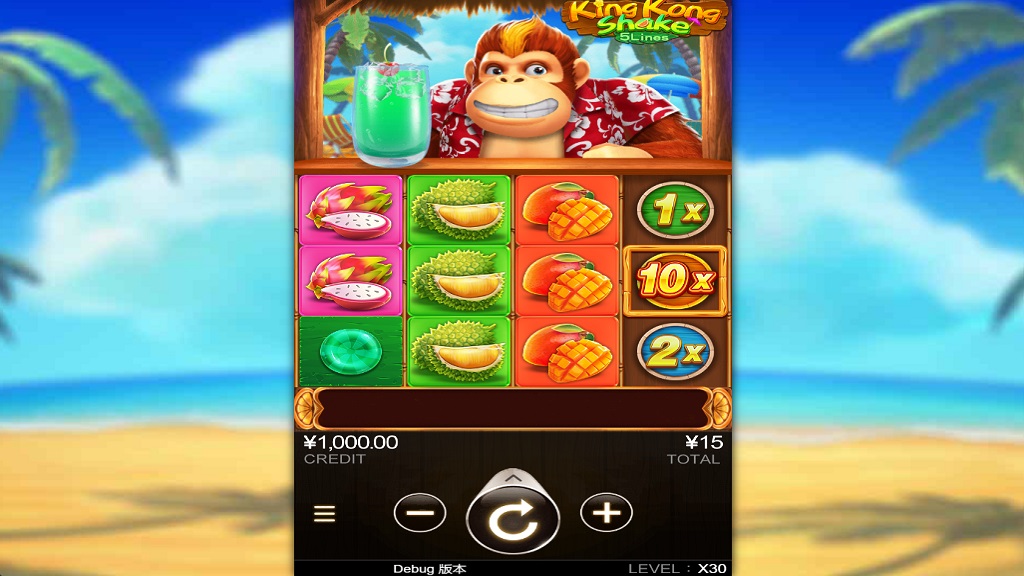
We have invested countless hours examining the framework of modern slot games, and we keep returning to a single, undeniable truth: the most ingenious mathematical models and impressive visual effects mean nothing if the player cannot navigate around the interface. In our assessment of King Kong Splash Slot, the navigational design does not merely serve as a background utility; it stands out as the primary reason for sustained engagement. We noted a fluidity that eliminates the cognitive friction usually associated with complex betting configurations. The developers have clearly focused on a layout where every control appears exactly where our instincts expect it to be, creating an immediate sense of mastery from the very first spin.
Auto-spin and Enhanced Session Management
For those of us who favor a more objective observation style, the advanced session management tools are a interface triumph. The autoplay configuration panel is a model of intuitive grouping. We discovered loss limits, single win limits, and spin counts organized into distinct visual cards, avoiding the mixing of integrating financial controls with mechanical ones. Toggling these limits appears robust, with clear on/off states that leave no ambiguity. We especially valued the real-time session tracker that discreetly ticks down remaining spins or displays current loss thresholds without encroaching on the main reel area. This enables us to maintain a organized approach to bankroll management while the base game navigation continues to work with the same fluid responsiveness.
The Pay Table and Access to Information
Transparency is a cornerstone of trust, and we observed the information architecture here to be remarkably clear. Accessing the paytable does not open a distinct, slow-loading PDF or a complex multi-page guide. Instead, a smooth overlay moves into display, displaying symbol values and payline charts with clear, high-definition sharpness. We could smoothly swipe through game rules, and the slot remembered our place if we shut the menu mid-way. The language used is brief, avoiding legalese where straightforward clarifications work. Critically, live figures within the paytable change in real-time to show our current stake multiplier. This real-time updating removes the mental math that often affects slot games, enabling us to quickly comprehend the specific monetary value of each possible combination we are pursuing.
Loading Speed of the Game and State Retention
Moving through the game commences long before the spinning reels show up; it starts with the initial loading screen. We evaluated the initial boot sequence and determined it adjusted to almost instant readiness on a stable connection. The non-existence of aggressive, non-skippable splash screens means we move from intention to activity in mere seconds. More significantly, the gaming session exhibits superb state retention. If network wavers, the interface restores smoothly, restoring our precise bet configuration and session state without reverting to default settings. We at no point had to navigate again the wager settings after a brief disruption. This reliability is a subtle, impactful feature of user-friendly design; it respects our earlier entries and eliminates the repetitive annoyance of re-adjusting, maintaining the path back the action as brief as achievable.
Stake Adjustment and Bet Setup Logic
We have come across countless slots where modifying a stake appears like handling a tricky device, with confusing coin values and level multipliers. The setup logic here is a welcome change. We valued the unidirectional slider that slides seamlessly from minimum to highest stake, paired with a clear numerical display of the total wager. There are no hidden sections for coin sizes that accidentally reset our preferences. The interface offers a obvious visual separator between low, mid, and high-roller zones on the bet spectrum. We also noted the clever safety warnings; if we attempt to play with a considerably higher stake, a understated, unobtrusive confirmation glow emerges, acting as a safeguard against accidental high-value bets without interrupting the momentum of the play.
Mobile Adaptability and Tap Tuning
We meticulously tested the game over numerous screen dimensions, and the flexible layout is authentically impressive. Instead than simply compressing the desktop interface, the orientation moves to a vertically refined stack that honors the ergonomics of single-handed gaming. We noticed that key contact areas never drop below the suggested 48-pixel limit, eliminating the irritation of errant taps during high-reward extra sessions. The swipe motions appear inherent to the unit, not tacked on. When we swiveled our screens, the rearrangement of parts was prompt, with no layout fracturing or content truncation. This commitment to adaptive framework validates that the mobile journey was the principal blueprint, not an second thought, guaranteeing that browsing remains intuitive regardless of the device in our grip.
The philosophy of Uninterrupted User Flow
We think that superior game design is hidden. When we analyze a slot, we actively look for moments of pause, those micro-pauses where the brain fumbles to locate the play button or the payout table. In this title, those moments are entirely missing. The creative approach tends to focus around a round eye-tracking pattern, leading our gaze naturally from the reels to the wager adjuster and back without demanding peripheral scanning. This is not an coincidence; it is a deliberate refusal of cluttered gaming layouts. By eliminating visual clutter and highlighting haptic-like visual feedback, the studio has crafted an setting where the player’s flow state remains unbroken, enabling us to concentrate solely on the escalating drama of the colossal ape’s special features.
Sound and visual Feedback as a Navigational Guide
We infrequently discuss sound in the context of navigation, but here it acts as a vital orienting tool. The interface utilizes a unique, layered audio pattern for different action types. A subtle, rising chime confirms a bet boost, while a richer, more full click fixes the spin. These auditory cues provide confirmation without forcing us to glance away from the reels. When we enter a bonus feature, the entire soundscape shifts, marking a modal change in the game state from a navigational standpoint before we even interpret the visual shift. This multi-sensory bolstering is vital for players who depend on rhythm. The visual feedback is likewise accurate; winning lines are highlighted with directional pulses that trace the payline path, teaching us the geometry of the game entirely through celebratory animation.
Spatial Design and Spatial Harmony
When we initially opened the game, the layout of elements of elements struck us as remarkably balanced. The reels hold the central position with an authoritative presence, yet they do not overpower the adjacent elements into obscurity. We saw a refined application of empty space that surrounds the gameplay without rendering the display feel hollow. The control panel is positioned to the bottom edge with a weighted, tactile feel that mimics real casino buttons. This spatial harmony ensures that our fingers, on handhelds, never overstretch, and our mouse pointers, on desktop computers, move minimal distances. The transparency levels of the overlay menus are tuned perfectly, enabling us to change settings while keeping a fuzzy visual link to the reels turning behind the menu panel.
The Centralized Command Hub
We discover that many rival slots distribute their interactive elements over differing corners of the screen, requiring a frantic visual search https://kingkongsplash.co.uk/. Here, the command hub functions on a concept of radial focus. The spin button, by far the most frequently used element, is not just more substantial but is positioned in a zone of natural thumb rest. Around it, we discover the autoplay and bet setup options emanating outward in a logical structure of occurrence. This grouping lessens precise motor tension during prolonged sessions. We specifically admire that the developers resisted the tendency to conceal secondary features like the turbo mode behind layered menus; these are accessible within the hub’s immediate vicinity, accepting that speed control is a central navigation necessity, not an subsequent thought.
Sight Emphasis and Button Markers
In our analysis of the design, we found that the on-screen signifiers conform rigorously to established global gaming norms. Buttons seem pressable; sliders appear draggable. There is a satisfying realistic quality to the components, with delicate gradients that attract the illumination, inviting use. We seldom had to guess whether an component was cosmetic or practical. The differentiation is attained through contrast ratios and a steady depth language that lifts interactive panels above fixed backgrounds. When a selection is executed, the tactile response is prompt, with a brief brightness pulse that confirms the entry without jarring us out of the gaming pace. This obvious transmission of functionality is a masterclass in lowering the learning curve to total zero.
Distraction-Free Immersion and Menu Opacity
We are especially responsive to layouts that shout for attention with glaring promotions and popup buy deals. The layout here promotes subtlety. Messages for achievements or balance changes glide in from the side with a subtle dim, conveying data without interrupting the engagement zone. The full-screen option is genuinely full-screen, hiding application chrome and system trays to establish a self-contained world. When we accessed the gaming regulations or history, the layer preserved a high transparency base, successfully dimming the wheels to push the content forward in our visual hierarchy. This handling of sight depth guarantees that when we are navigating the configurations, we are not distracted by the slot, and when we are gaming, we are not harassed by the configurations.
In summing up our analytical analysis, we find that the browsing framework of this game is its unseen killer feature. Every swipe, tap, and tap appears planned to serve the user’s comfort and pace. The design does not just facilitate play; it dynamically enhances the theme excitement by eliminating every conceivable barrier between the user and the raw roar of the upcoming huge win. It stands as a benchmark for how thoughtful design and adaptive reaction can transform a standard game session into a seamless lesson of player experience.